

The ongoing reconstruction of Douglas Road in Owerri is more than a road construction project; it is a deliberate and visionary effort to restore order, improve public safety, and redefine the commercial landscape of Imo State’s capital city.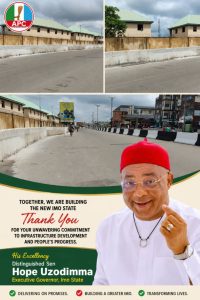
For decades, Douglas Road has remained the commercial heartbeat of Owerri. Unfortunately, it also became synonymous with street trading, persistent traffic congestion, indiscriminate obstruction of pedestrian walkways, and environmental disorder. Several administrations attempted to address these challenges, but lasting solutions remained elusive.
Today, Governor Senator Hope Uzodimma has demonstrated remarkable ingenuity by going beyond simply reconstructing the road. He has incorporated practical engineering solutions designed to preserve the integrity of the project for years to come.
One of the most striking innovations is the construction of approximately four-foot-long and one-foot-wide reinforced concrete barriers on both sides of the road, strategically positioned before the drainage channels. This seemingly simple but highly effective feature serves as a physical deterrent against the return of illegal street trading and unauthorized encroachment on the roadside.
This is not merely concrete. It is thoughtful planning translated into durable infrastructure.
By preventing indiscriminate occupation of the road shoulders, the government is ensuring that Douglas Road remains accessible to motorists, safe for pedestrians, and free from the congestion that previously hindered commercial activities. The drainage system will also be better protected from blockage caused by refuse generated through roadside trading, thereby reducing flooding and extending the lifespan of the infrastructure.
Critics may view these barriers as restrictive, but responsible governance sometimes requires firm decisions that ultimately serve the greater public interest. Every modern city enforces standards that balance commerce with order, and Owerri should not be an exception.
Street trading, while providing livelihoods for many, must be accommodated within designated markets and properly planned commercial spaces rather than on major highways where it poses risks to lives, businesses, and public infrastructure.
Governor Hope Uzodimma deserves commendation for recognizing that sustainable urban development is not achieved merely by laying asphalt but by anticipating future challenges and embedding preventive measures into every project.
The reconstruction of Douglas Road is therefore a masterpiece of infrastructure planning -one that combines aesthetics, functionality, safety, environmental sustainability, and urban discipline.
As the project nears completion, one message becomes increasingly evident: the era of indiscriminate street trading along Douglas Road is gradually coming to an end. What is emerging instead is a modern commercial corridor befitting a state capital with aspirations for economic growth and orderly development.
Indeed, this project reflects leadership that plans not just for today but for tomorrow. If properly maintained and supported by consistent enforcement, Douglas Road will stand as one of the enduring legacies of Governor Hope Uzodimma’s administration and a reference point for urban renewal across Nigeria.
Ejiakor, Williams Ezeikpe
Public/Political Affairs Analyst.
